

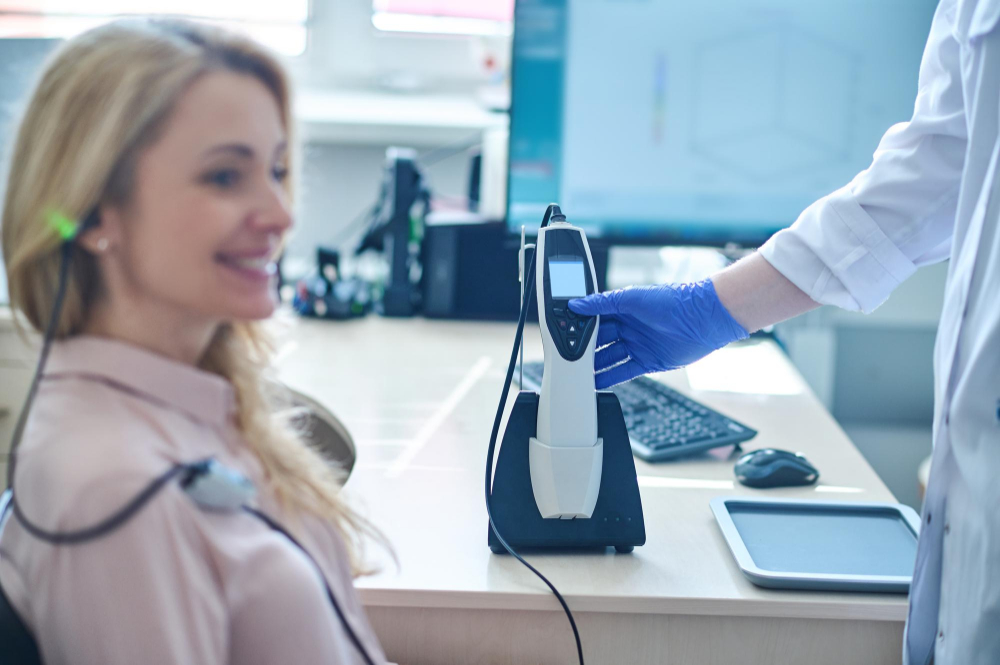
Pure tone audiometry is a structured hearing test that requires consistency, clear instruction, and careful observation. While the process may seem straightforward, small errors in setup, communication, or technique can affect the results. That’s why clinicians follow a step-by-step approach to ensure reliable threshold measurements.
What Are the Key Steps for Conducting Pure Tone Audiometry?
Pure Tone Audiometry (PTA) is a hearing test that determines the softest sounds a person can detect across different frequencies and sound levels. Contrary to popular belief, conducting this test involves more than simply playing tones and recording responses. Each phase affects how hearing thresholds are identified. A consistent process helps reduce variability, improve patient reliability, and ensures results can be interpreted correctly.
The steps below follow standard clinical practice and can be adapted depending on the patient’s condition, testing environment, and equipment used.
Preparation & Setup
Proper setup lays the foundation for accurate testing. If this step is rushed or overlooked, the results may not reflect the patient’s true hearing ability.
- Control the environment: It’s important to use a sound-treated booth. If unavailable, choose the quietest room and minimize interruptions. Even low background noise can mask soft tones.
- Verify equipment calibration: Ensure the audiometer meets current calibration standards (such as ANSI or ISO). Outdated calibration can shift threshold readings.
- Check transducers: Inspect headphones or insert earphones for damage and proper function. Position them correctly, as misplacement can lead to false thresholds.
- Seat and position the patient: The patient should sit comfortably, facing away from the examiner to avoid visual cues.
- Remove obstructions: The patient needs to remove glasses, earrings, or anything that may interfere with headphone placement.
- Review basic history: Briefly ask about ear pain, recent infections, or noise exposure. These factors may affect test results or require caution.
Instruction
Clear and simple instructions are critical. Poor instruction is one of the most common reasons for unreliable audiometry results.
- Explain the task clearly: Tell the patient they will hear tones at different pitches and volumes, and they should respond whenever they hear a sound, no matter how soft.
- Demonstrate the response method: Show exactly how to respond (button press, hand raise, or verbal signal).
- Set expectations: Let the patient know that some sounds will be very faint and may feel uncertain. Encourage them to respond even if they are not fully sure.
- Run a short practice: Present a few audible tones to confirm the patient understands how to respond.
- Reinforce consistency: Remind them to respond every time they hear a tone and not to guess when unsure.
Frequencies Tested
Testing the right frequencies ensures the results reflect both general hearing ability and speech understanding.
- Start at 1,000 Hz: This frequency is typically easy to detect and helps establish initial reliability.
- Test the standard range: Include 250, 500, 1,000, 2,000, 4,000, and 8,000 Hz. These cover the frequencies most relevant to everyday hearing.
- Retest 1,000 Hz: Repeat this frequency after the initial run to confirm consistency. A large difference may indicate unreliable responses.
- Add inter-octave frequencies if needed: Frequencies like 3,000 or 6,000 Hz can help detect noise-induced hearing loss patterns.
- Adjust based on findings: If thresholds drop sharply, additional frequencies may be tested to better define the hearing profile.
Testing Procedure
The testing procedure focuses on identifying the softest level of sound the patient can detect at each frequency.
- Begin with an audible level: Start at a level the patient can clearly hear (commonly around 30–40 dB HL).
- Apply the threshold method: Use the “down 10 dB, up 5 dB” approach to narrow down the hearing threshold.
- Look for consistent responses: The threshold is confirmed when the patient responds at least 50% of the time at a given level.
- Avoid predictable timing: Present tones at irregular intervals to prevent the patient from guessing.
- Watch patient behavior: Look for signs of hesitation, fatigue, or false responses, and adjust pacing if needed.
Order of Testing
- Start with the better ear: If the patient identifies one ear as better, test it first. If not, begin with the right ear by convention.
- Complete air conduction first: Test all required frequencies using air conduction before moving to other methods.
- Move systematically across frequencies: Follow a consistent sequence (e.g., 1,000 → 2,000 → 4,000 → 8,000 → 500 → 250 Hz).
- Switch ears and repeat: Once one ear is complete, repeat the same process on the other ear.
- Introduce bone conduction when indicated: If air conduction thresholds suggest hearing loss, proceed with bone conduction testing.
Recording Results
Proper recording ensures the data can be interpreted and used for diagnosis or follow-up.
- Plot thresholds immediately: Record results on the audiogram as you test each frequency to avoid errors.
- Use standard symbols: Follow accepted notation for air and bone conduction in each ear.
- Document exact thresholds: Record values in dB HL for each frequency tested.
- Note test conditions: Include details such as transducer type, masking (if used), and any deviations from standard procedure.
- Flag reliability issues: If responses were inconsistent or affected by external factors, make a note for proper interpretation.
What Are the Types of Testing
Pure tone audiometry includes several hearing testing types that work together to give a complete picture of hearing function. Each type isolates a different part of the auditory system, which helps clinicians identify where a problem may be occurring.
Air conduction testing is the standard starting point. It delivers sound through headphones or insert earphones and evaluates the full hearing pathway—from the outer ear, through the middle ear, and into the inner ear. Because it covers the entire system, it provides an overall view of hearing ability.
Bone conduction testing focuses on the inner ear by bypassing the outer and middle ear. A bone oscillator placed on the mastoid sends vibrations directly to the cochlea. This method helps determine whether hearing loss is due to a blockage or issue in the outer/middle ear or a problem within the inner ear itself.
Masked testing is used when there is a noticeable difference between ears. Without masking, the better ear may detect sounds presented to the poorer ear, which can distort results. By introducing controlled noise into the non-test ear, masking ensures that responses come only from the ear being evaluated.
Together, these testing types allow clinicians to differentiate between conductive, sensorineural, and mixed hearing loss, and to assess the extent of each.
Screening Procedure
Screening audiometry is a faster, simplified version of pure tone testing. It is designed to identify possible hearing concerns rather than provide a full diagnostic profile.
In a screening setup, tones are presented at fixed intensity levels—commonly 20 or 25 dB HL—across key frequencies such as 1,000, 2,000, and 4,000 Hz. These frequencies are chosen because they are critical for understanding speech.
The patient is asked to respond whenever they hear a tone. If they respond to all tones at the set levels, the result is typically recorded as a “pass.” If they miss one or more tones, the result is marked as a “refer,” indicating the need for a full diagnostic evaluation.
Screening is widely used in schools, workplaces, and routine health checks. While it does not replace comprehensive audiometry, it plays an important role in early detection. Identifying potential hearing issues early allows for timely follow-up, which can improve outcomes and prevent further decline.
Conclusion
Pure tone audiometry follows a structured and methodical process. Each step contributes to the final results. Clinicians can assess hearing with much more confidence when different testing types are combined, following consistent procedures. This not only helps identify hearing loss but also supports early intervention and appropriate treatment planning.