
If you have never had a hearing test before, it is normal to wonder what will happen during the appointment. Will it hurt? How long will it take? What will you actually have to do?
A professional hearing test is usually straightforward and painless. Your audiologist or hearing care professional will typically discuss your hearing concerns and health history before examining your ears and performing the hearing tests appropriate for your situation. The exact tests can vary depending on your age, symptoms and hearing history.
Knowing what to expect at a hearing test can make your first appointment feel much easier. Here is what you can expect from the moment you arrive to the point when your audiologist reviews your results.
How Long Does a Hearing Test Take?
Hearing test Toronto clinics typically take about 45 minutes to an hour, depending on the assessment required. The appointment is usually divided into three parts:
- A discussion about your hearing and health history
- The hearing assessment, which may include otoscopy, tympanometry and audiometry
- A review of your results and recommendations
Your audiologist will explain each test as you go, and most parts of the assessment are painless.
What Happens During Your First Hearing Test?
A first hearing test is more than simply putting on headphones and listening for beeps. A comprehensive assessment looks at different parts of your hearing and ear health to give your audiologist a clearer picture of how you hear.
Discussing Your Hearing and Medical History
Your appointment will usually begin with a conversation about your hearing and general health. You may be asked when you first noticed a change in your hearing, which situations are difficult for you and whether you have experienced symptoms such as ringing in your ears or ear pain.
You may also be asked about previous ear infections, family history of hearing loss, exposure to loud noise and medications that can affect hearing. This information helps your audiologist put the test results into context.
It can help to think about your hearing before the appointment. For example:
- In which specific situations do you struggle most to hear (e.g., noisy restaurants, group chats, watching TV?
- Do family members or friends complain that you ask them to repeat themselves or turn up the television?
- Do you experience discomfort when wearing headphones, earphones or earplugs?
- Do you regularly use cotton swabs (Q-tips) or other tools to clean your ears?
- Do you feel like you have a heavy buildup of earwax right now?
These details can be useful during your first hearing test appointment.
Examining Your Ears
Next, your audiologist or hearing care professional may perform an otoscopy, which involves looking inside your ear canal with a lighted instrument called an otoscope. This examination can help identify visible concerns such as earwax buildup, irritation, signs of infection or a foreign object.
A Canadian survey found a difference between self-reported hearing problems and hearing loss identified through audiometric testing. More than 70% of adults with audiometrically measured high-frequency hearing loss did not report having hearing loss or a hearing-related diagnosis.
An ear examination can provide additional information about the condition of the ear before or alongside hearing tests.
Pure-Tone Hearing Test
Pure-tone audiometry is one of the main parts of a standard hearing assessment. You will usually sit in a quiet or sound-treated room and wear headphones or earphones.
Your audiologist uses an audiometer to play tones at different pitches and volumes. Each time you hear a sound, you will respond by pressing a button, raising your hand or giving another agreed signal. The sounds can become very quiet, allowing the audiologist to determine the softest sounds you can hear at different pitches.
There is no need to worry about getting the answers right. You simply respond whenever you hear a tone, even if you are not sure how loud it is.
Your responses are recorded and later plotted on an audiogram, which helps show how well you hear different frequencies.
Speech Testing
A hearing test may also include speech audiometry. Instead of listening only for tones, you will listen to spoken words and repeat what you hear.
The words may be presented at different volume levels. Some tests may also use background noise to assess how well you understand speech when there are other sounds around you.
This matters because hearing well is about more than detecting sounds. Someone may be able to hear that another person is speaking but still have difficulty understanding the words, particularly in busy environments.
Bone Conduction Testing
If needed, your audiologist may perform a bone conduction test. A small device is placed behind your ear or on your forehead. It produces vibrations that travel through the skull directly to the inner ear, bypassing the outer and middle ear.
You will respond when you hear the sounds, just as you do during pure-tone testing.
Comparing bone conduction results with air-conduction results can help your audiologist assess the type and possible site of hearing loss.
Tympanometry and Other Tests
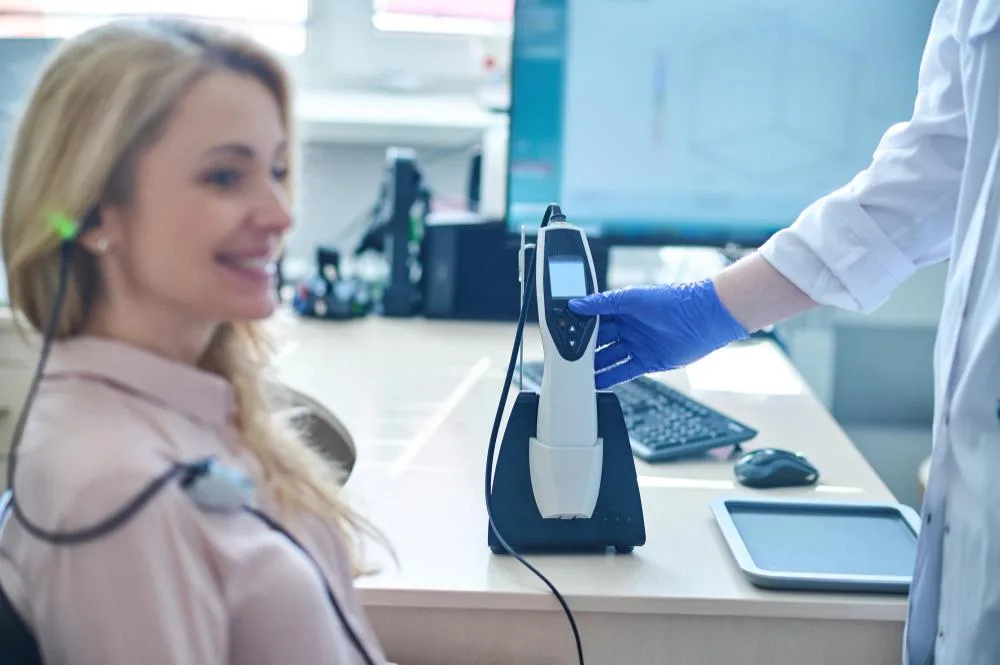
Tympanometry measures the movement of your eardrum and can help assess the condition and function of the middle ear. Your audiologist places a small probe into the ear canal. The device changes the air pressure in the ear and measures how the eardrum responds.
This test can help identify issues such as fluid or pressure problems in the middle ear.
Depending on your age, symptoms and hearing history, your audiologist may also recommend other tests. Not everyone needs every type of hearing test, so your assessment will be tailored to your needs.
Audiogram Explained: Understanding Your Hearing Test Results
Once the testing is finished, your audiologist will review the results with you. You will typically receive an audiogram, a graph that shows how softly you can hear different pitches.
The audiogram helps show whether hearing loss is present, whether it affects one or both ears, and how significant it is. Hearing thresholds are measured in decibels, while the frequencies tested range from lower-pitched to higher-pitched sounds.
A hearing test is not a pass-or-fail exam. The results give your audiologist information about your hearing and help guide discussions about appropriate next steps.
Your audiologist can explain what the results mean in practical terms and answer any questions you have about your hearing. If the assessment identifies hearing loss or another ear-related concern, they can also discuss appropriate next steps.
How to Prepare for Your First Hearing Test Appointment
You do not need to do much to prepare for a hearing test. Still, taking a few minutes to think about your hearing concerns can help you get more out of your appointment.
Before your appointment, think about when you first noticed changes in your hearing and any specific concerns you want to discuss with your audiologist.
It can also help to bring any previous hearing test results or relevant medical information you have. If you use hearing aids or other hearing devices, bring them with you as well.
Most importantly, come prepared to describe what you are experiencing. Your answers can give the audiologist useful context when interpreting your test results.
What Happens After a Hearing Test?
Once your results have been reviewed, your audiologist will discuss whether you need any follow-up or treatment.
If hearing loss is identified, the next step depends on its type, severity and possible cause. Your audiologist may recommend monitoring your hearing, hearing protection, further assessment or hearing aids, depending on your individual needs.
If your results do not show hearing loss, the appointment can still provide a useful baseline for future hearing assessments. Having a record of your hearing can make it easier to identify changes over time.
At Bloor Hearing Clinic, our hearing test service includes time to review your results, discuss your hearing care options and answer your questions.
Once your results have been reviewed, your audiologist will discuss whether you need any follow-up or hearing care. If you’d like to learn more about the professionals who provide these assessments, you can meet our audiologists.
When Should You Get Your Hearing Tested?
You do not have to wait until hearing problems become severe before getting a hearing test. An assessment can be useful if you have noticed changes in how you hear or if people around you have started pointing them out.
Some common signs include difficulty following conversations in noisy places, frequently asking people to repeat themselves, turning up the television volume, or having trouble understanding speech even when you can hear that someone is talking.
Ringing or other sounds in your ears can also be a reason to have your hearing checked. If you are noticing any of these signs of hearing loss, a hearing assessment can provide more information about your hearing and help determine if further assessment is needed.
Regular hearing tests can also be useful as you get older. Your audiologist can recommend how often you should have your hearing checked based on your age, hearing history and individual risk factors.
Is There a Free Hearing Test for Seniors in Ontario?
If you are looking for a free hearing test for seniors in Ontario, it is important to distinguish between a hearing test and funding for hearing devices.
At Bloor Hearing Clinic, hearing tests are available at no cost for adults over 60. OHIP coverage for hearing tests provided by audiology clinics may vary. Private insurance plans may also cover audiology services depending on your policy. If you have questions about the process before booking, you can also review these common hearing test questions.
Ontario’s Assistive Devices Program (ADP) provides funding toward certain hearing devices for eligible residents. Eligibility and funding requirements vary depending on the individual and the device.
The program is not limited to seniors and does not automatically make a hearing test free.
If you are unsure what you may qualify for, ask the clinic about the cost of your assessment and whether your insurance or other programs may provide coverage.
Frequently Asked Hearing Test Questions
Will a Hearing Test Hurt?
A standard hearing test is generally painless. Most of the appointment involves listening to sounds, responding to the audiologist and having your ears examined.
Some parts of the assessment may feel unusual, such as tympanometry, which changes the air pressure in your ear canal to measure how your eardrum responds. However, it should not normally be painful.
If anything feels uncomfortable during the appointment, let your audiologist know. They can explain what you are feeling and adjust the test if needed.
How Often Should You Have a Hearing Test?
How often you should have your hearing tested depends on your age, hearing health, symptoms and risk factors. Your audiologist can recommend an appropriate schedule based on your individual situation.
You should also book a hearing test if you notice a new or worsening change in your hearing, regardless of when you had your last assessment.
What Happens If a Hearing Test Shows Hearing Loss?
If your hearing test shows hearing loss, your audiologist will explain the results and discuss the options available. Depending on the type and severity of hearing loss, this may include monitoring your hearing, hearing protection, medical follow-up or hearing aids.